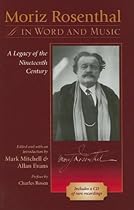
Moriz Rosenthal in Word and Music: A Legacy of the Nineteenth Century
| Author | : | |
| Rating | : | 4.11 (875 Votes) |
| Asin | : | 0253346606 |
| Format Type | : | paperback |
| Number of Pages | : | 208 Pages |
| Publish Date | : | 2014-10-06 |
| Language | : | English |

DESCRIPTION:
Inclusive music libraries serving readers at all levels.Choice (Choice)"These recordings and others will satisfy the curiosity that must be provoked by the opportunity here afforded; and, for that opportunity, we must acknowledge the informed and valuable work of Mark Mitchell and Allan Evans." —Chronicles, July 2006 (Chronicles 2006-01-00)"This is a valuable work for pianists and an enjoyable read for everyone. Each piece of the puzzle is important to the understanding of this giant in the piano world. And then like icing on the cake: an audio CD recorded fairly late in Rosenthal's life, which reveals him as a remarkable interpreter of Chopin. Much like the picture that emerges when one pieces together a jigsaw puzzle, a picture of Moriz Rosenthal (1862, 1946) emerges from the many bits of information Mitchell and Evans have assembled here. Rosenthal's slight autobiography (20—plus pages) helps
Mark Mitchell is the author of Virtuosi and Vladimir de Pachmann both published by Indiana University Press. He lives in New York City.. He is the recipient of a John Simon Guggenheim Fellowship for 2006-2007.Allan Evans is the founder, owner, and producer of Arbiter Recording Company
"Outstanding and historic recordings!" according to Charles H. Darakdjian. Hello,I am still reading the book, but I will comment on the audio CD. Marvelous!Etude in Gb - During the first half of the piece, Maestro Rosenthal blasts through, and I am going to write him off as another virtuoso, but then he switches gear and starts putting some real soul in the piece. He has a completely different take on this piece, with his blitzkrieg ending which he plays instead of the double octave finish which I found very interesting.Blue Danube - Genius! I am going to hassle my local music store to find a copy of this dynamite transcription. Liberace plays the Blu. "A rare document of a bygone era" according to Chernabog. This book is not really a book written entirely by its authors. It is a more collection of previously unpublished and published (but rare to find) essays written by Rosenthal himself. What the authors did was translate them carefully and insert comments in order clarify and correct certain excesses of wit from Rosenthal's pen. Also a wonderful introduction written by Charles Rosen (probably Rosenthal's last student) deserves special praise. And as dessert a CD with rare recordings of Rosenthal himself. What could we expect more?Highly recomended!!!. "Rosenthal--A Man Apart" according to Rugby. Previously well-reviewed by Rick, the following excerpts should whet one's appetite for a work I could not put down, history alive, sprinkled with anecdotes of the famous and legendary, Rosenthal's thoughts on life,art,pianism,humanity, insights into an age gone but retrievable if its lessons are learned, hearts are so inclined:Mikuli,Chopin's student,teaches Rosenthal the master's legatissimo playing in which the sound glows and grows even after the key is released,to which Rosenthal soon adds the heroic utterances of Rubinstein, the spiritualism/vision of Liszt.Joseffy presen
In these striking pieces, we see every facet of Rosenthal: memoirist, social critic, pedagogue, and virtuoso. This volume combines Rosenthal’s writings with critical assessments of the pianist by such contemporaries as Eduard Hanslick, Edward Prime-Stevenson, and Hugo Wolf. He could write with gravity and pathos, yet his famous and sometimes devastating wit is legendary. It is rounded out with an illuminating preface by Charles Rosen, perhaps Rosenthal’s most renowned pupil; a discography and concertography; and a CD featuring never-before-released Rosenthal recordings.. As a pianist, Rosenthal was unparalleled: his legato touch came from Chopin through his pupil Mikuli; his awareness of composition was developed by Liszt; his Brahms interpretation shaped by the composer himself; and his ingeniously crafted piano-paraphrases memorialized his friendship with Johann Strauss II. Yet Rosenthal’s pianistic abilities were married to a rare intellectual erudition—a knowledge of literature, history, philology, scienc